
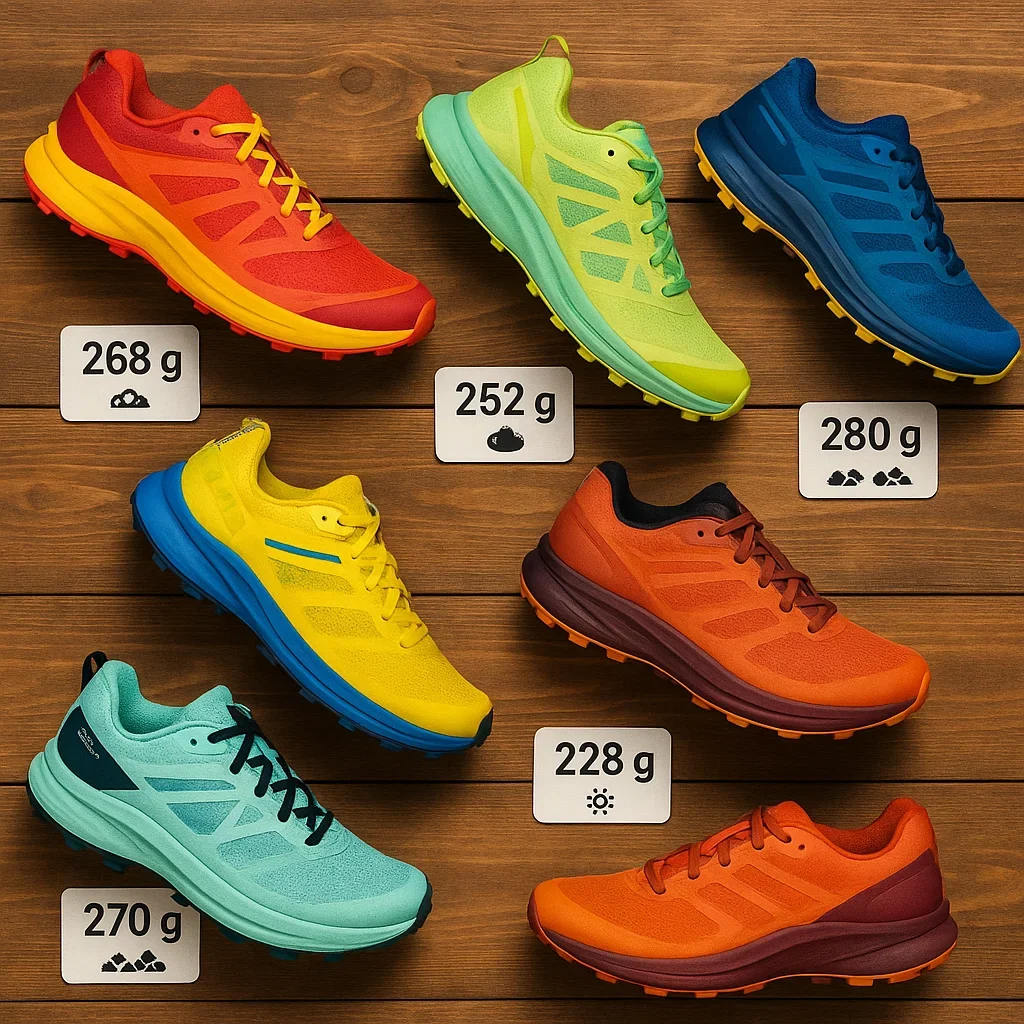
Lightweight trail running shoes are changing the 50K ultra marathon game.
Are they right for you? Will you fly through the course, or crash from lack of protection?
This guide breaks down everything: pros, cons, key models, runner profiles, decision charts and more.
| 🏆 Pro | ⚠️ Con |
|---|---|
| Lightweight = more speed, less fatigue | Less protection from rocks, roots, hard landings |
| More agility, nimble on technical terrain | Lower cushioning: foot fatigue after 30+ km |
| Faster transitions, uphill efficiency | Durability may be lower than “tank” shoes |
| Cooler and more breathable in hot races | Less stable with heavy packs or at slow pace |
✨ What Makes a Trail Shoe “Lightweight” for 50K?
- Weight: Under 270g per shoe (men’s US 9) is the “gold standard.”
- Midsole: Lower stack, firmer foams for direct feel and rapid foot turnover.
- Outsole: Aggressive but thin lugs—grip without weight penalty.
- Upper: Minimal overlays, airy mesh, welded (not stitched) reinforcements.
- 👍 Yes if: You want speed, race on mostly dry trails, have good form, and finish in under 7 hours.
- 👎 No if: You’re new to ultras, often walk or hike, or the course is super rocky/technical.
🕵️♀️ Lightweight vs Cushioned Trail Shoes: Head-to-Head
| Feature | Lightweight | Cushioned/Heavy Duty |
|---|---|---|
| Avg. Weight (Men’s US 9) | 210–270g | 280–350g+ |
| Stack Height | 18–25mm | 28–36mm |
| Protection | Moderate | High |
| Ground Feel | Maximum | Low to Medium |
| Fatigue Resistance | Good (for trained runners) | Excellent for most |
| Best For | Dry, rolling, fast 50Ks | Rough, rocky, mountain ultras |
- YES if you’re chasing a PR, the trail is mostly smooth, and you’re experienced.
- NO if you expect lots of walking, sharp rocks, or you want maximum comfort at all costs.
- MAYBE if you’re a mid-pack runner but have trained in similar shoes—test in a long run!
🥇 Best Lightweight Trail Running Shoes for 50K (2025)
| Model | Weight | Stack/Drop | Best For | Notes |
|---|---|---|---|---|
| Salomon Pulsar Trail Pro 2 | 270g | 29mm/6mm | Fast, technical, dry | Race feel, snappy |
| Adidas Terrex Speed Ultra | 245g | 26mm/8mm | Speed, light technical | Great for fast 50K |
| Inov-8 Trailfly G 270 | 270g | 22mm/0mm | Minimal, agile, mixed | Graphene grip |
| Hoka Zinal 2 | 221g | 24mm/5mm | Light, rolling | Super agile, responsive |
| Merrell Skyfire 2 | 230g | 21mm/6mm | Speed, shorter ultras | Best for dry/hot |
| La Sportiva Kaptiva | 240g | 24mm/6mm | Technical, firm | Close fit, mountain use |
- Test on real trail: Never decide based on store feel—run at least 10K in similar conditions.
- Prioritize fit: Slightly roomier toe box is best for swelling on ultras.
- Rotate shoes: Alternate lightweight with a more cushioned pair in training to reduce injury risk.
- Mind the outsole: If your 50K has mud, don’t pick “dry only” shoes—look for mixed-lug patterns.
- Are you aiming for a fast finish time (top half of the field)?
- Do you train regularly in shoes under 270g?
- Is your race mostly dry, smooth, or moderate terrain?
- Do you recover quickly from long runs in low-cushion shoes?
– Sam, sub-6 hour ultra finisher
❓ Frequently Asked Questions
🏋️ Do lightweight shoes really reduce fatigue over 50K?
⛑️ Are lightweight shoes risky for beginners?
🦶 Can wide-footed runners use lightweight models?
🌦️ Are they good for wet or muddy races?
🔄 How long do lightweight trail shoes last in ultras?
📚 Further Reading
- iRunFar: Best Trail Running Shoes
- Runner’s World: Trail Running Shoes Guide
- Switchback Travel: Best Trail Running Shoes (2025)
Final Thoughts
Lightweight trail running shoes unlock speed and agility—but demand strength and smart training. If you’re ready, they can take your 50K ultra to the next level! Always test before race day, rotate your pairs, and never let hype outweigh comfort and fit.
🗣️ Real Runner Stories: Lightweight Shoes for 50K Ultras
– Lina, 50K trail finisher, 6:48
– Jackson, sub-6 hour 50K
– Michelle, 50K ultra coach
– Owen, 50K podium finisher
⚡ Practical Tips: Making Lightweight Shoes Work for YOU
- Start Small: Integrate lightweight shoes into your weekly training on short/medium trail runs before committing to them on race day.
- Sock Strategy: Lightweight shoes often have thinner uppers—test different socks to avoid rubbing, blisters, and keep a spare pair for race day swaps.
- Pace Adjustments: Your legs may feel amazing early, but late-race fatigue can creep in—consider conservative pacing in the first 30km.
- Foot Care: Trim toenails, use anti-chafe balm, and consider taping hot spots if you’re prone to blisters in minimal uppers.
- Rotation: Train in a mix of lightweight and regular-cushion shoes to build resilience and prevent overuse injuries.
- Test Nutrition: Less shoe = more feedback from rocks/roots; distracted runners are more likely to trip—don’t neglect fueling and hydration focus.
| Runner | Experience | Course Type | Lightweight Outcome | Lessons Learned |
|---|---|---|---|---|
| Lina | 1st 50K | Rolling, mostly dry | Fast pace early, sore feet after 40km | Needs more minimal shoe training |
| Jackson | Experienced | Rooty, technical | Agile, avoided rocks, managed blisters | Taping & sock change key |
| Michelle | Coach, many ultras | Mix, moderate elevation | Needed to rotate shoes to avoid calf overuse | Alternate cushion in training |
| Owen | Podium-level | Fast singletrack | PR with lightweight; terrain matched perfectly | Course choice critical |
Lightweight shoes can elevate your 50K, but only when matched to your foot strength, terrain, and preparation. There’s no one-size-fits-all—be your own test subject, and your race-day results will speak for themselves!

About the Author
Lost Pace is an ultramarathon runner, shoe-tester and the founder of umit.net. Based year-round in Türkiye’s rugged Kaçkar Mountains, he has logged 10,000 + km of technical trail running and completed multiple 50 K–100 K ultras.
Blending mountain grit with data, Lost analyses power (CP 300 W), HRV and nutrition to craft evidence-backed training plans. He has co-written 260 + long-form guides on footwear science, recovery and endurance nutrition, and is a regular beta-tester of AI-driven coaching tools.
When he isn’t chasing PRs or testing midsoles, you’ll find him sharing peer-reviewed research in plain English to help runners train smarter, stay healthier and finish stronger.
Ultrarunner · Data geek · Vegan athlete