
What’s the best trail running shoe for a 50K ultra marathon?
Every foot, every race, every terrain—different. But you can choose like a pro. This guide gives you the decision flowcharts, comparison tables, mini quizzes, real runner stories, and expert tips you need.
Run with confidence. Finish with a smile.
🗺️ Decision Flow: Choosing Your Optimal Shoe for a 50K Ultra
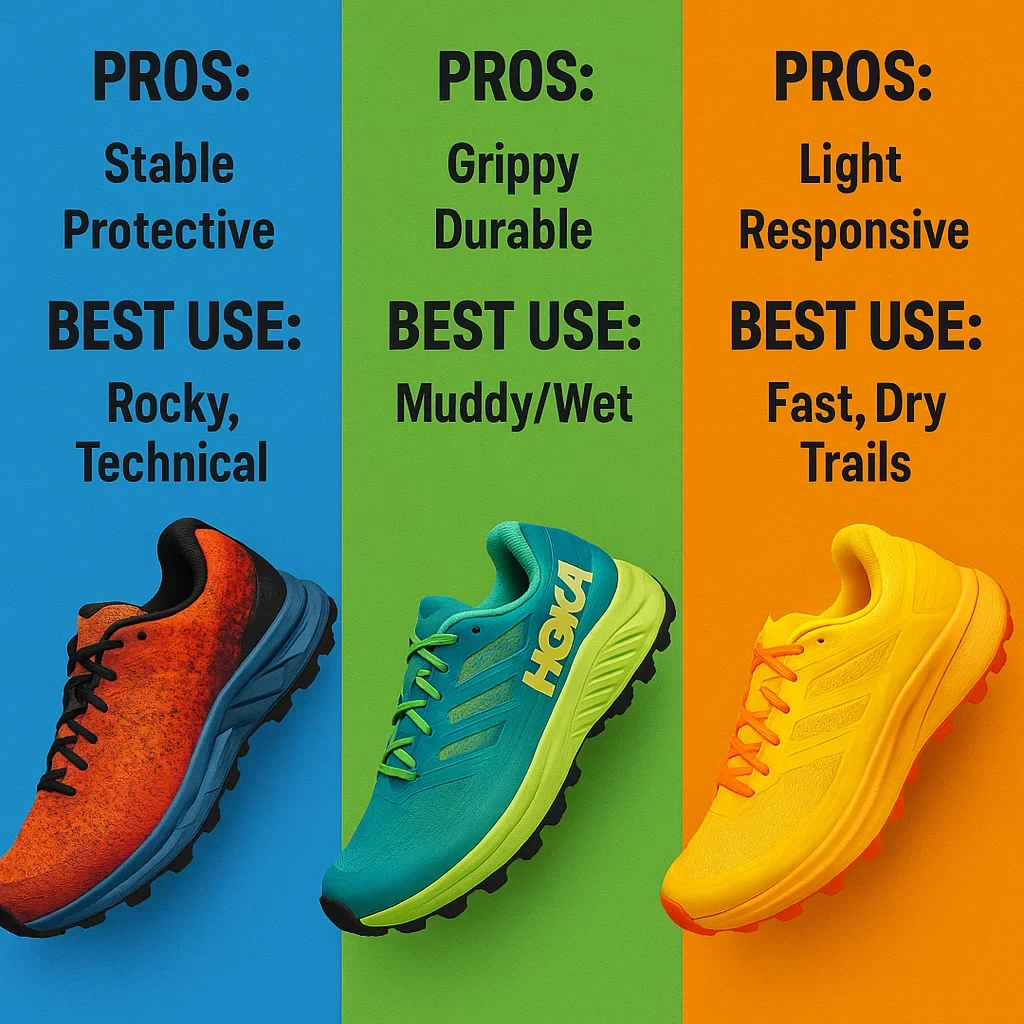
- Terrain Type: Rocky/Technical? → Grip & protection key → Stiff, aggressive lugs, solid upper.
- Muddy/Wet? → Drainage, lug depth → Waterproof or quick-drain mesh, aggressive outsole.
- Dry/Fast? → Lightweight & responsive → Minimal upper, cushioned midsole, racing fit.
- Foot Type: Wide or bunions? → Choose natural fit models (Altra, Topo, some Hoka).
- Narrow or heel slip? → Go for snug, gusseted tongue (Salomon, La Sportiva, Inov-8).
- Injury History: Prone to plantar/knee/ITB pain? → Max cushion & arch support (Hoka, Brooks Cascadia).
- Racing or Finishing? Need speed? Go lighter. Want comfort? Go plush, stable.
- Test in training: Don’t trust marketing—log at least 2-3 long runs/race simulations!
🥇 Top Trail Shoes for 50K Ultra – By Terrain & Foot Type (2025)
| Model | Best For | Fit Type | Key Features | Pro Tip |
|---|---|---|---|---|
| Hoka Speedgoat 6 | Rocky, mountain, mixed | Medium, stable | High cushion, grippy Vibram, wide toebox | Great for injury-prone & long days |
| Salomon Sense Ride 6 | Technical, variable, all-weather | Snug, secure heel | Quicklace, moderate cushion, rock plate | Fast lacing for mid-race adjustments |
| Altra Lone Peak 8 | Dry, buffed, wide feet | Natural, roomy | Zero drop, flexible, wide toe splay | Best for natural stride and toe comfort |
| La Sportiva Bushido II | Rocky, technical, wet roots | Narrow/secure | Sticky grip, close fit, durable upper | Ideal for narrow feet or skyraces |
| Brooks Cascadia 17 | Mixed, wet, all-day | Medium, plush | Stable, cushioned, protective toe cap | Good all-rounder for most runners |
| Inov-8 Trailfly G 270 | Fast, dry, technical | Snug, minimal | Lightweight, flexible, Graphene grip | For forefoot strikers, speed focus |
| Topo Athletic Ultraventure 3 | Mixed, wide, high volume | Wide, high volume | Cushion + roomy fit, secure heel | Ideal for swelling feet, long ultras |
- Is your course mostly rocky, muddy, or dry and fast?
- Do you need wide, natural fit or snug, secure heel?
- Do you prefer plush cushion or “ground feel” minimal?
- Have you struggled with injuries (plantar/knee/ITB)?
- How long is your expected finish time (under 6h, over 8h)?
Mostly “B” = Seek wide/natural fit models.
Mostly “C” = Try maximalist shoes.
Mostly “D” = Try minimal/lightweight shoes.
🏃♀️ Runner Stories: Which Shoes Won Their 50K?
– Jessie, mountain ultra finisher
– Martin, trail runner
– Jane, technical course specialist
🔗 Explore More 50K Guides
- Know your terrain: Technical, muddy, dry, mixed?
- Understand your foot: Wide/narrow, high/low arch, blister history?
- Decide on cushion: Maximalist (long/rocky) or minimalist (fast/light)?
- Test the fit: Try with race socks; run at least one long effort (20+ km).
- Evaluate durability: Read real reviews, check wear points (midsole, outsole, upper).
- Rotate pairs: Break in your race shoes, but don’t wear out before the big day!
- Plan drop bags: If possible, stash a backup shoe at halfway or aid station.
🧼 Race Prep: Last-Minute Shoe & Foot Tips
- Wash and fully dry your shoes 2–3 days before race day.
- Check laces and eyelets for weak spots—replace if needed.
- Patch small holes with fabric glue or athletic tape.
- Trim your toenails (not the night before!) to avoid black nails/blisters.
- Test socks + shoes combo on a long run to avoid friction surprises.
- Prepare a backup pair for drop bag if possible.
- Mark your shoes with your name/number if in a big race!
❓ Advanced FAQ: Trail Shoe Selection for 50K Ultras
👟 What is the most important feature for a 50K shoe?
🏞️ Should I choose based on terrain or my running style?
🧦 Which socks pair best with trail shoes for ultras?
❌ What mistakes should I avoid when buying?
🛒 Is it worth buying two pairs for a 50K?
🏆 Pro Tips & Common Pitfalls: Nail Your 50K Shoe Choice!
- Tip: Always run at least one 30+ km training session in your race shoes and socks—never trust “out of the box” comfort.
- Tip: Beware “trend” models—what works for elites may not suit your pace or body.
- Mistake: Sizing up “just in case”—leads to sloppy fit and blisters. Secure but not tight is key.
- Mistake: Ignoring lacing systems—try lock lacing, heel lock, or Salomon Quicklace for best hold.
- Bonus: Keep a shoe log (mileage, terrain, issues). Data beats memory!
📚 Further Reading & Related Articles
Share This Guide with Your Running Crew!
Final Thoughts
The “perfect” 50K trail shoe is the one that fits your foot, matches your terrain, and makes you confident through every climb and descent. With the right preparation and a smart test run, you’ll go farther and finish stronger. Keep learning, stay curious, and enjoy every mile—see you at the starting line!

About the Author
Lost Pace is an ultramarathon runner, shoe-tester and the founder of umit.net. Based year-round in Türkiye’s rugged Kaçkar Mountains, he has logged 10,000 + km of technical trail running and completed multiple 50 K–100 K ultras.
Blending mountain grit with data, Lost analyses power (CP 300 W), HRV and nutrition to craft evidence-backed training plans. He has co-written 260 + long-form guides on footwear science, recovery and endurance nutrition, and is a regular beta-tester of AI-driven coaching tools.
When he isn’t chasing PRs or testing midsoles, you’ll find him sharing peer-reviewed research in plain English to help runners train smarter, stay healthier and finish stronger.
Ultrarunner · Data geek · Vegan athlete